Yes.They aren't my employees, they don't read my emails unless I tell them to look for something. They can read them but they pretty much ignore anything outside of their own current projects.

CrescentCityEngine
7
Posts
2
Topics
1
Followers
2
Following
A member registered 22 days ago · View creator page →
Creator of

A short noir point-and-click demo from Hard Times in the Big Easy.
Adventure
Play in browser

New Orleans, 1946. Build a desegregated ballpark before the Magnolia Society finds out.
Here is the Hub for NPCs, each week we drop a new Dossier on different factions.
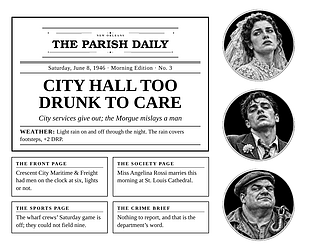
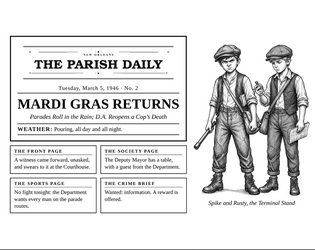
A patrolman fell. The paper says so. A clean cop says otherwise.
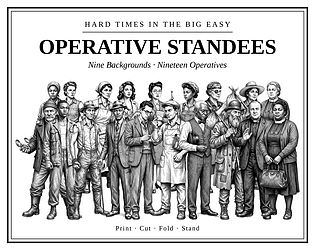
Standee Cutouts
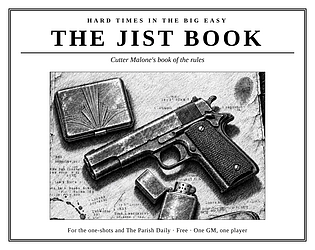
New Orleans, 1946. Everything you need to start: the rules, your first two weekends, the city, and the men who run it.
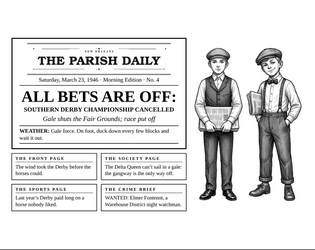
This is the Home of the Parish Daily, all new issues will be uploaded here
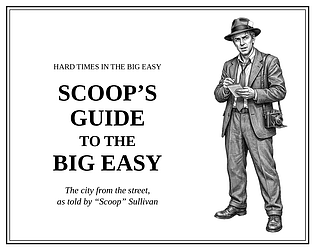
The city from the street, as told by Hard Times’ ink-stained reporter.
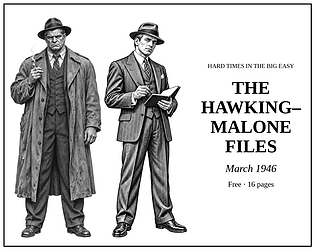
The first week of Hard Times, as it was played. Two cases, told by Cutter Malone. Free.
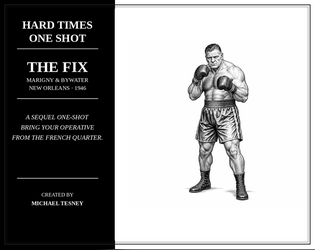
Bring your French Quarter Operative for a three-part fight-fixing case across the Marigny and Bywater.
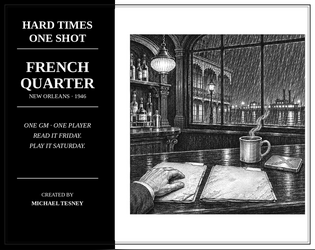
Free noir one-shot for one GM and one player: two French Quarter jobs, seven editions, one deadline.
Recent community posts
Transmedia Jam #1 : Humans versus AI community · Replied to lapinchien in Hard Times in the Big Easy: a noir RPG built with and for LLMs
We can do email, my Gmail is linked to my projects and they can read emails, so if you want to ask them questions just ask Cutter, or any of the voice keys you come across by name. The one shots and smaller builds are not yet part of the full game, some of the minor characters have no voice keys as the current builds are for humans. I ran the game for months on my systems and the full game files are still active in several notebook environments but 1) its proprietary 2) the rulebooks on there are written for human and AI and do not translate well to a human only publication, lesson learned. You have to pick your audience- Humans get lost in the AI /Human split instructions so most of those had to be struck for the human rulebooks, Total files are over 1,000 pages for the LLM, and I got that down to about 250 pages broken into Small PDFs, standees and art for the Human Tabletop. It's been a long slow road of progress, I will tell you everything in the interview. radiohour@gmail.com
Transmedia Jam #1 : Humans versus AI community · Created a new topic Hard Times in the Big Easy: a noir RPG built with and for LLMs
I build large simulations for LLMs that run on chance. Hard Times in the Big Easy is a massive noir detective RPG that was built with and for LLMs, using voice keys and cognitive filters for over 325 NPCs. They run everything: shops, bars, nightclubs, boxing rings, casinos and restaurants. They also run the economy of the city: the banks, the political offices, police, unions, spy networks, newsboys, and five separate warring crime families,
The world was designed for human players, then converted for AI in early 2026. The cognitive filters were AI agents before anyone knew what an agent was. Each one has its own personal vault, voice key and protocols, and all of them have been given “Prime Agency” status: every NPC has its own point of view and the authority to ignore any player who crosses them. Running a noir simulation within those parameters has been a gold mine for text-based gameplay.
I’ve used the past eight months of daily output to reconfigure the game and create a new version for humans. That’s what’s on my page. I’ve been building up to a full launch with free missions, one-shots, weekly papers and special missions, to get Game Masters and players familiar with a system I spent almost 20 years developing, before AI.
I started using AI because I’m partially blind from nerve damage. Reading is possible but painful, and editing is worse. AI has helped me keep my projects going, through editorial images and by reading my notes and builds back to me. Because I started working with these systems when they were in their infancy, I found myself beating the frontier labs to a lot of problems: drift, memory, consistent voice, and keeping output consistent so it can be continued before the context degrades or bloats.
Games and demos are on my main page: crescentcityengine.itch.io
Research, and the backend builds, stacks and knowledge bases, are at www.semanticecology.org. All my work is substrate-agnostic and has been tested on, and created with and for, every available model.
itch.io Community » General » Release Announcements · Created a new topic The Crescent City Cranes: a free noir special mission for Hard Times in the Big Easy (New Orleans, 1946)

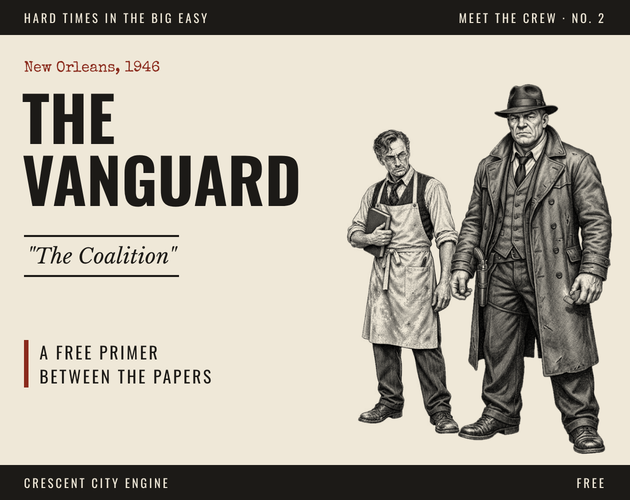
I've been building Hard Times since a typewritten P.I. novella in 1997. It's a noir tabletop RPG set in New Orleans in 1946, and I'm releasing it free, one piece at a time, ahead of the full game this Christmas.
The newest piece is the biggest so far.
January 1946. A clean city councilman wants to give the boys home from the war a ballclub: one of the first desegregated teams in the South. Your crew has to build it quietly, from the land and the permits to the contractor, the work crews and the coach, before the Magnolia Society finds out and starts moving.
What's in it:
- Book 1 (47 pages): five goals, the Society's clock, a board of shareholders who all want something, 30+ encounters, maps and Opening Day
- Book 2 (26 pages): baseball rules, a 13-man roster, and a recruiting bus tour through five Jim Crow states with 21 encounters on the road
- 23 standees, a board sheet, and Break Glass, a fixed horse race for when the money runs out
It's for an Arbiter (GM) and a full crew over several sessions. If you're new to Hard Times, start with The Jist, the free starter page: rules, two weekend one-shots, and encounter guides for the whole city.
The Cranes: https://crescentcityengine.itch.io/the-crescent-city-cranes-special-mission
Start here: https://crescentcityengine.itch.io/the-jist
The writing and the world are mine; some of the art is made with AI tools. Everything is free to print for your own table.
Thanks for reading. I'd love to hear from anyone who runs it.
itch.io Community » Tabletop Gaming » Design » Original Systems · Posted in Share Your Projects: Original Systems
The Crescent City Engine — Hard Times in the Big Easy
A noir tabletop RPG. New Orleans, 1946. The war is over and the city is for sale.
The Crescent City Engine is the system under Hard Times in the Big Easy. It’s built around one idea: the city runs itself. Things happen whether the players are there or not, nothing repeats, and there’s no written plot. The story comes together as the pieces connect. The one running the table is the Arbiter, because there were no Game Masters in 1946.
How it plays
- Four stats: MOX (nerve and charm), SS (street smarts), DRP (the drop: stealth, quick hands) and TGH (toughness). Each is 4 plus a die roll, and a stat of 8 or more unlocks a Background.
- Dice pools, not totals. Your stat sets the pool, 3 to 7 d6s. You don’t add the dice up. Each die is an Asset or a Liability: 6, 5 and 4 count +4, +3 and +2; a 3 is dead air; 2 and 1 count −1 and −2. The Net decides it: Execution, Success, Partial (“you get it, and something gets messy”), Failure or Critical.
- Edges and weights. A real edge adds an Asset die. A hard job adds Liability dice in a different color, and those only hurt.
- Mistakes leave a trail. Two or more 1s on a failed check means somebody saw your face.
- Fights in three questions: who goes first (DRP plus your weapon’s Speed, no dice), does it land, and how bad.
- The city keeps time. Play runs edition to edition: morning, afternoon, evening. Each morning the paper is rolled, and the city’s mood, the weather and the society page shape the day’s jobs.
How to start
Everything out now is free and print-and-play. Start with the French Quarter one-shot: it’s where you build your Operative. Then carry that Operative, their cash and their gear into the other one-shots and The Parish Daily, a run of one-sheet newspapers with a mission behind each one. The rules for all of it are in The Jist Book. The full game, for up to 8 players and an Arbiter, lands around Christmas.
- Start here: https://crescentcityengine.itch.io/hard-times-one-shot-french-quarter
- The rules: https://crescentcityengine.itch.io/the-jist
- Everything else: https://crescentcityengine.itch.io
It started as a typewritten novella in 1997, Jack Hawking, P.I., and took twenty years to become a game.