This is a well done collage-point-and-click game! There's a few different moments of discovering how one can interact with the image layers -- gives it a sense of peeling back a dream.

bibliomancer
Creator of
Recent community posts
There's so many really well-tuned bits here. I love how the ladders initially feel so loose and then reveal their strange logic of use. And the item titles are fantastic.
I hit a snag a few times trying to enter the painting room from the raising platform (I'd see it for a flash and then be falling into the below room again), but maybe it's just player error!
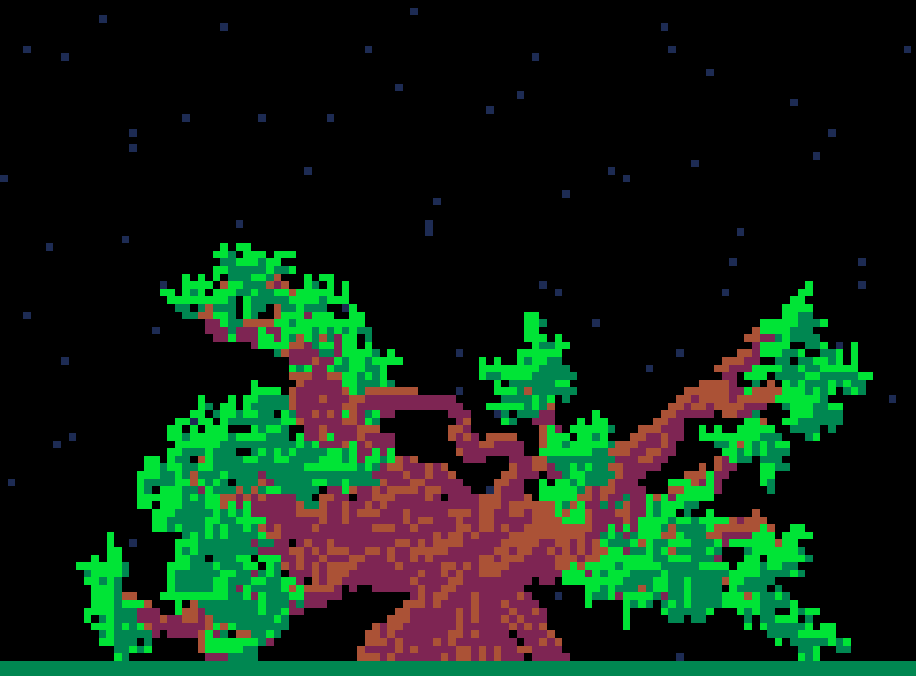
I'm really impressed with this! What at first I assumed would be just a fun little tree-making toy turned into thinking quite a lot about how to move in relation to the emergent growth from my previous steps -- following the bark to lead to a longer growth period is a really elegant strategy here.
I had fun trying to make the most horizontal tree I could!
Have you read CAConrad's (Soma)tic poetry rituals? This feels in the same kind of conversation! https://www.caconrad.com/somatic
I finally spent some time with this piece and glad I did. You use the dithering so well here, it adds both granular texture but also patches of ambiguity that fit Borges's text so well. Same with how it feels to navigate the fields, which occasionally made me think, "wait... have I already seen this?" (in a way that's very effective for this labyrinth). Of course, gotta love an excellent credits page that leads me down even further Wikimedia mazes.
I was thinking about the screenshots you have on this page, where you've given the cards a black background. I think that effect works really nicely for the claustrophobia of this piece and really makes the contrast pop. It also makes the cards seem even more sculptural! I wonder if it's worth embedding a version of this deck in an otherwise pitch black webpage and seeing how that fits the experience?
Thanks! It was a bit tricky to make the most of the limited variations that made possible by FlickGame's constraints (there's only 16 discrete screens available).
I'm thinking these things as sonnets with influence from Ted Berrigan's The Sonnets, where he's still working with patterns of constraint and relation in the sense of a sonnet, but not necessarilyl adhering to historic formal rigidity. I like how The Poetry Foundation puts it:
"...the sonnet, Berrigan demonstrated, was not fourteen lines of iambic pentameter, but rather a form essentially grounded in certain intricate relationships of cadence and meaning."
At the same time, to me there's something about the effect of FlickGame's constraint of a hard 16 screens that tickles my brain in the same way as trying to squeeze a textual poem into a tight 14-line traditional sonnet. It's *close* to a similar number of lines vs. screens, and it still requires thinking through efficiencies vs. rhythm (for example, I wanted to also make the nose/eyebrows independently wiggly but it simply wasn't an option to keep alongside the eyes and mouths).
When I re-read Berrigan's sonnets, I get the sense of them as a project he was dipping in and out of, over time, and squeezing his writing of them in and around his daily life (no idea if that's actually true). Especially when he's reincorporating and recontextualizing lines from previous ones. So I suppose I'm thinking of that kind of process here too -- these flickgame sonnets as walking the line between something I'm dashing off on a weeklyish basis but also something that requires me to zoom in, on a small scale, and think about the pacing and relationships between each screen/line. And something that's required to be attuned to their own material constraints.
Oh this is lovely! I've been thoroughly enjoying this game (and perhaps sinking too much time into it with my morning coffee each day).
Having a guide will be a great help but I've also been loving how the game gently teaches you these systems through trial and error. It's been really pleasing to feel each of my cities get iteratively better as I understand the systems. (Maybe I'll wait a bit longer before reading the manual after all...)