

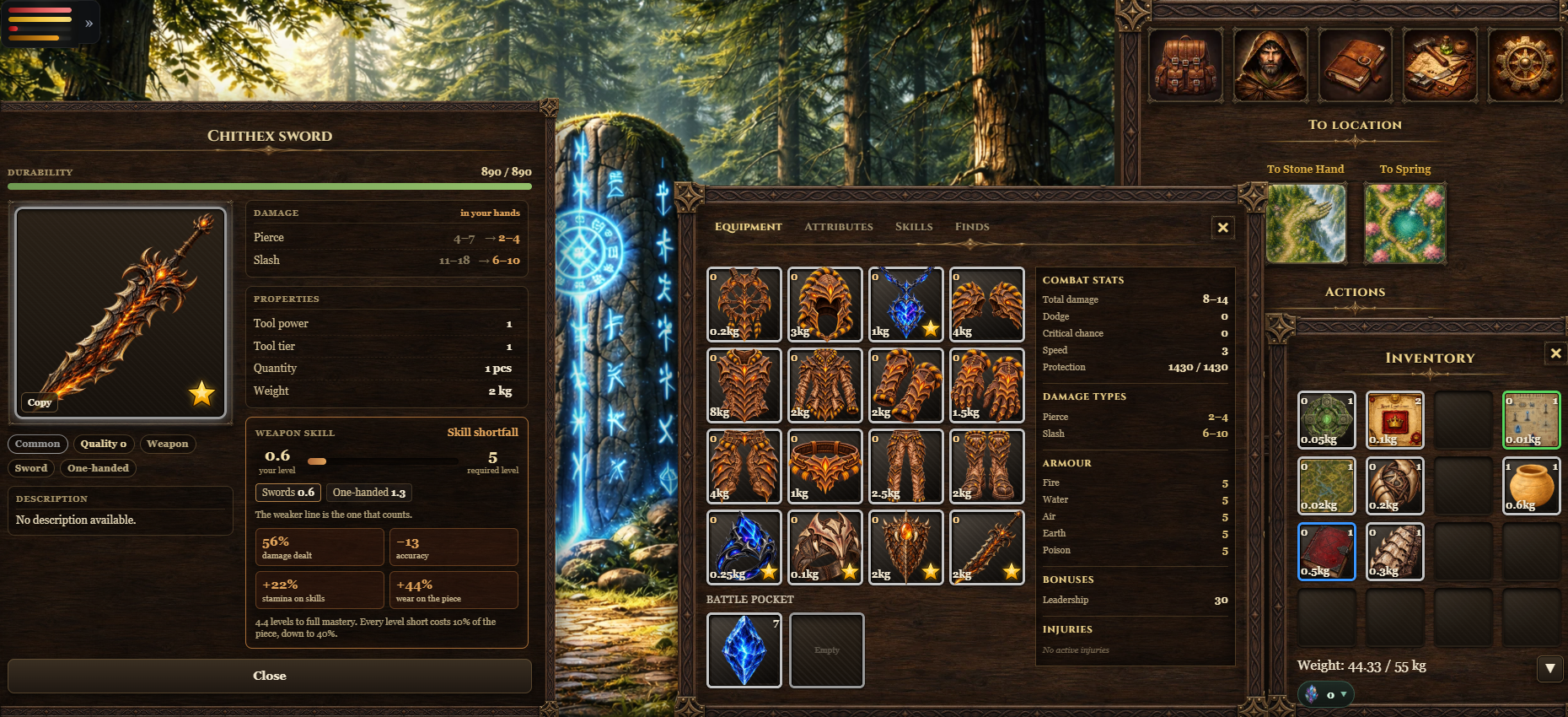
New chithex set from second dungeon, A LOT of rebalancing, a lot of fixes and more.
Weapon wear: how it works now
The old random wear is gone. Your weapon now wears by the damage it deals, so durability is the number of kills a weapon has in it.
Durability = damage budget Every swing costs durability:
wear = rolled damage ÷ (2.5 × efficiency)
- Damage is counted before the target's armour. A swing wears the weapon the same whether it lands, misses or hits a shield.
- Overkill counts: hitting a nearly dead rat with a huge blow still costs the whole blow.
- Area attacks wear by the total damage dealt to every target hit.
- Thrown weapons wear the same way, on a hit or a miss.
- Getting hit no longer wears your weapon.
Efficiency Efficiency is how much damage you get per point of durability.
- Weapon mastery tier 0 / 5 / 10 → 50% / 75% / 100%
- A few weapons have their own value. For example, wooden spear 45%, boneshard sword 60%.
- Tools, shards and anything not made as a weapon are inefficient: 20–45%.
- Fist in gloves: 50%, paid from the gloves' protection pool.
- Quality and rarity raise efficiency, together with damage and durability. A good weapon hits harder, lasts longer and pays less per point of damage, so a rare Q3 weapon gives several times more kills than a common Q0 one.
Damage type vs creature Creatures have separate armour for each damage type: blunt, cut, pierce, slash, plus elemental types.
- Armour is subtracted from each damage type separately. If the armour is equal to or higher than that part, that part does nothing.
- Wear doesn't care: you pay for the full roll either way.
Example: a blow of 10 against 2 armour deals 8. The same blow against 8 armour deals 2. Both cost the weapon the same.
So using the wrong damage type against an armoured creature burns your weapon for nothing. Weapons that split damage into several types are great against soft targets. Against heavy armour, each part gets cut down on its own.
Cutting work Butchering and carving use the same rule. Skinning a rat carcass costs about a fifth of a kill.
In short: match the damage type to the creature, train your mastery, use better weapons, and don't waste big hits on targets that are almost dead.
Oh, also creatures got perks.
Creature perks: how they work
Creatures from the deity lines (Scurren, Chithex, Orael, Cloverine, Nerax) and the Darkness now have a character: a set of perks. Villagers and NPC heroes have no perks.
What a perk is Every perk gives a bonus and has a penalty. Each perk also has its own rarity. The bonus is always full; rarity only reduces the penalty:
| Rarity | Penalty kept |
|---|---|
| Common | 100% |
| Uncommon | 80% |
| Rare | 60% |
| Epic | 40% |
| Legendary | 20% |
| Mythic | 0%, no penalty at all |
Slots A creature can hold one perk per evolution: evo 1 = 1 slot, evo 3 = 3 slots. Evolving gives a new slot, but never a perk.
Wild creatures Wild creatures are born with perks and fight with them. Most have none. About 1 in 5 has at least one, and rarely a creature has 2–4 (limited by its slots). If you capture a creature, it keeps its perks. Its monolith piece carries all of them.
The perks (penalties shown at Common)
- Fat: +30% HP / −20% speed
- Thick-skinned: +2 physical armour / −25% stamina
- Quick: +25% speed / −20% HP
- Agile: +5 dodge / −1 physical armour
- Fierce: +5 crit / −5 dodge
- Strong: +20% damage / −25% stamina
- Piercing: +2 physical penetration / −5 crit
- Enduring: +40% stamina / −15% damage
- Fearless: immune to fear / −5 dodge
- Fire / Water / Air / Earth skin: +5 armour against that element / −5 against its opposite
- Tireless: +20% satiety capacity / −15% HP
- Modest: eats 25% less / −10% damage
- Glutton: +15% damage / eats 25% more
- Carrier (expeditions): +5 carrying slots / 20% chance of fear at turn start
- Leader (expeditions): leads group expeditions / −50% to all stats
Changing perks
- Monolith piece: an enchanted creature absorbs a piece and is offered every perk that piece carries. If the piece has one perk and the creature has a free slot, the creature learns it automatically.
- Aromatic Snejka (monolith fruit) offers one random perk with a random rarity.
When a perk is offered, you decide in the nursery: put it into a free slot, replace one of the creature's perks, or take nothing. A creature can't hold the same perk twice, but a new copy can replace the old one, for example to upgrade its rarity. While a choice is waiting, the creature can't absorb another piece or perk fruit.
Bestiary
The battle card shows how many perks an enemy has. When your knowledge of that creature reaches 50%, you see their names. Your journal remembers the perks you've seen on each kind.